Friday, December 2, 2011

Top Sewing Machine Questions

The Top Eight Sewing Machine Questions
by David Trumble

Q1: What makes a sewing machine?

Since the first sewing machine was patented in 1846, it has essentially been a mechanical appliance used to connect materials together using needle and thread. Today, we think of the sewing machine largely as an appliance to join fabrics.

Question 2: Are there different types of sewing machines?

While many people think of sewing machines only in terms of their standard home sewing machine, there are hundreds of sewing machines designed for specific applications at home and in factories. Since sewing machine are either used in a home or factory setting we might say there are two broad kinds: Home and Commercial or Home and Industrial. At home you will find the typical home sewing machine, a serger, an embroidery machine, an embellishing machine, quilting machines, a blind hemming machine, and sometimes a light industrial straight stitch or zig zag machine. In industry, you will find much more rugged and faster sewing specialty machines often used for a single application. Here you can find walking foot machines, blind stitch machines, upholstery machines, leather machines, button machines, machines to make shoes, saddles, sails, and more.

Q3: What are the typical kinds of home sewing machines today?

All home sewing machines look about the same, but the insides have big differences. We can group them into three categories: mechanical, electronic, and computerized. Inside a mechanical machine you discover an AC motor, gears, levers, and shafts. In electronic machines, you see electronic devices controlling power distribution and stitch selection. Computerized sewing machines incorporate advanced technologies to provide power control, stitch formation, stitch information, and numerous convenience features. Mechanicals are the most limited in features, stitches, and capabilities, while computerized machines offer the most features, stitches, and capabilities.

Question Four: Why do sewing machines range so much in price?

Sewing machines sell for between $100 and $12,000 dollars. The price clearly reflects a combination of considerations: dependability, durability, features, convenience, and capabilities. The more you pay the less frustration you get. The less you pay the less capability and performance you have. Over $1,000 you find super quality sewing machines some with hundreds of stitches and even embroidery capabilities. Around $500, you find a good solid machine with a limited stitch set. Under $100, you get junk hardly worth taking home.

Why do we need a sewing machine?

The sewing machine is an amazingly versatile device that unleashes almost unlimited creative potential. You can use a sewing machine for garment construction, wearable art, embellishment, embroidery, endless home decorating projects, heirloom creations, quilting, crafting, and so much more. When you add all the specialty machine applications common in industry, sewing machines are vital for so many different tasks.

Q6: How do you choose the best sewing machine for me?

You best sewing machine or the right one for me will do two essential things: Empower me to create and reduce your frustrations in the process. You can find your machine by making sure it has the capabilities and features you want and need. If you buy value instead of just price, you benefit every time you sew.

Question Seven: What is the difference between a regular sewing machine, a serger, and an embroidery machine?

At the center of every home sewing center is the home sewing machine. This is the versatile machine used for so many different applications involving seams. Still, if you enjoy sewing, you will treasure the benefits of the home serger. It actually seams, overcasts, and trims all in one high speed step saving time and energy. You may also enjoy the embroidery machine which is a single purpose machine designed to sew beautiful preprogrammed designs.

Question 8: Where can I get a new sewing machine?

While you can buy sewing machines over the internet and in department stores, these merchants offer no support, instruction, or service. You may not need these with a simple microwave oven, but to get the most from your sewing machine, you need all three: support, instruction, and service. Better quality sewing machines are only sold through authorized sewing machine dealers. When you purchase a machine from one of these dealers, you receive much more than a machine in a box. You get expert advice and assistance. You get professional repair and maintenance service. And you get very helpful sewing machine instruction. To get the most from your sewing machine investment, find your trusted local sewing machine dealer.

Get more about sewing machine repair with Dr. David Trumble's complete Sewing Machine Repair Manuals. Check out his free beginner's course. Also check out his other sewing resources learn to sew, how to sew, and other sewing sights including http://www.SewAndQuiltStore.com, http://www.SewingMachineMall.com, http://SewingAnswers.com, and http://www.FixSewingMachines.com.

Wednesday, May 18, 2011

Fix Sticky Serger Stitches

What Do You Do With Skipped And Sticky Serger Stitches?

When you push on the foot control, you expect your serger to zip along serging a perfect stitch in an endless seam. When the stitch fails to form or skips hear and there, it causes horrific frustration. The sheer number of threads make serging a challenge. It sews so fast, up to 1500 stitches per minute, that serging can be a bit unnerving.

Consistent stitching, proper thread placement, and fine balanced tensions form quality stitches. Puckers, irregularities, and loops are noticeably absent.

Failure to form a stitch and skipped stitches are two of the more frustrating challenges serger users experience. These problems require a concerted effort to identify the causes and find solutions.

The most common causes of skipped stitches and unformed stitches include needle problems, threading problems , thread issues, faulty tensions, fabric issues, snagging, and misalignment of either looper timing or needle bar height or both. Check each possible cause and eliminate one of the at a time.

Start by replacing the needle or needles involved. Needle burrs, flaws, and bends are common causes of skipped stitches. Make sure the needles are fully seated in their holders.

Serger needle positioning is critical. Some sergers use ordinary sewing needles that have flat back tops, but many use special needles with rounded tops. On the front of the needle is a groove for the thread to ride in while the needle goes down. On the back and just above the eye is a cut out space known as the scarf. The scarf must be at ninety degrees to the lower looper. Make sure the needle is straight forward and properly seated in its holder. Use the right needle for the application you are doing.

The needle bar height must be properly aligned in order for stitches to form. It can be dislodged by the needle striking hard surfaces, needle breakage, or by sewing through very heavy materials.

Threading is also a very common source of difficulties. To fix this problem, rethread properly. Be alert to anything that might snag the thread.

Not all threads are equal. Some thread work better, some worse. Rethread with separate color threads or easier tracking. Make sure tensions are right.

Generally, sergers work on all fabrics, however, certain challenges can emerge with super thin, slippery, or thicker fabrics require accommodations.

Failure to form stitches usually results from the same causes as skipped stitches, but the issues are more pronounced. It is a matter of degree. If a serger issue causes skipped stitches, it is only a matter of time before stitches fail to form at all.

Apply the same approaches to seek solutions. One additional tip, however, is to clear the stitch finger and draw the theads under and behind the presser foot prior to starting to serger.

Generally, when the stitch quality is less than acceptable there are some basic things to check every time. These include needles, thread and threading, tensions, loopers, snag causes, settings, and balance. Replacing needles properly, rethreading properly, and adjusting tension balance are the three basic approaches to solve stitch problems. Get help from our professional sewing machine technician if you continue seeing problems.
If you decide to consider buying a new serger, besure to check out the resources at www.SewingMachineMall.com. They offer great reviews and resources to help you find the best serger or sewing machine.

Learn information about how to repair a sewing machine from Dr. David Trumbles excellent courses and sewing machine repair book. Download a copy of his free beginner's course.

Tuesday, November 23, 2010

Centering The Needle To Repair Your Sewing Machine

Does your needle penetrate the needleplate properly?

This is an often overlooked element that can create loads of problems.

If the needle is even slightly out of proper position in any direction, it will adversely affect the stitch formation and tension of the stitching.

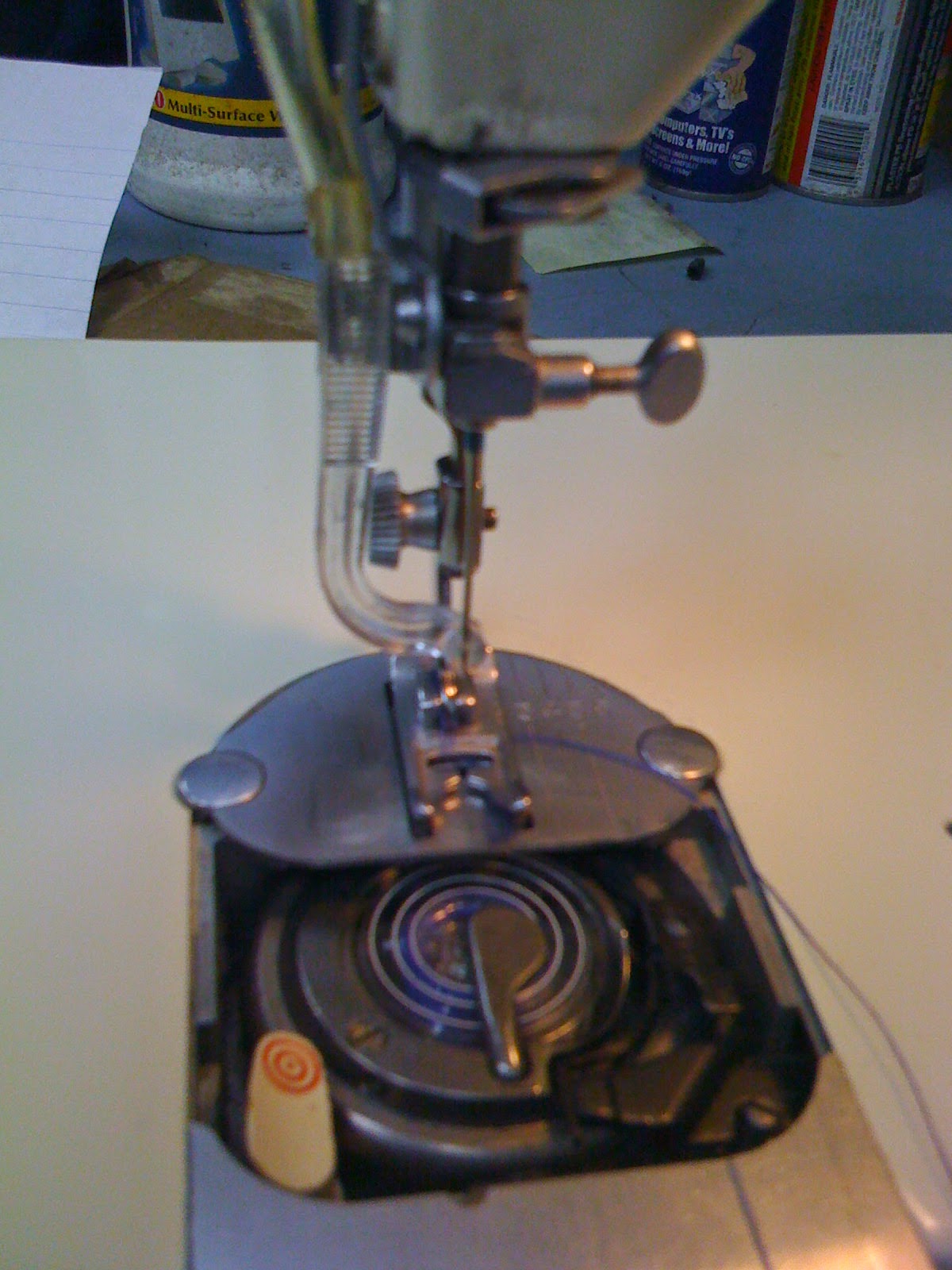
More specifically, the needle must be positioned so that it centers in the needle plate front to back, side to side, default prositioning, and needle bar height. Setting these positions is a major part of any sewing machine repair.

Lets look at these in reverse order: The needle bar height is set by a set screw on the needle bar clamp. The point of the needle must move down through the needle plate hole, into the bobbin carrier area, and begin rising as the point of the hook passes behind the scarf of the needle. If the point of the needle passes too high or too low, poor stitches, irregular stitches, intermitten stitches, or no stitches may result.

To properly set the needle bar height, visually trace from the needle up the bar until the bar passes through the hole in the head and then up until you see a clamp with a set screw in the center. This is the adjusting screw.

Rotate the hand wheel toward you until the needle moves to its lowest position. It must not strike anything. Rotate just slightly until the point of the hook is ready to pass behind the needle. The point of the hook must pass behind the scarf or cut out in the back of the needle and above the eye. If this is not happening, loosen the set screw mentioned previously. Adjsut the bar up or down without turing it. Retighten the set screw.

Next set the machine to its default needle position. Some machines default to a center position, while others use a left needle position. In either case, make sure the needle is properly positioned. If center positioning is used, the needle must enter the needle plate in the exact center of the needle hole. If left position is used, the needle should clear the left side of the hole but match the left most position. In some machines multiple position is used. In these cases, make sure the center position matches properly.

To adjust this positioning, visually trace the needle bar up to the bracket you referenced to adjust height. Note an arm connects to the right of this bracket and goes to another connection. This connection has an eccentric screw to adjust the left to right positioning. A set screw may or may not hold this eccentric in position. Loosen the set screw and adjust the eccentric until the needle is properly positiioned. Test by rotating the hand wheel through one complete needle bar action up and down.

Next note that there is another arm running from this connection and reachinging back to the cam tracker. In the center of this arm is another set screw or eccentric to control how far left or right the needle moves. Adjust so that the needle penetrates the needle plate inside the edges of the hole on the right and left.

Finally, the needle must be positioned properly front to back. This is called the hook-needle clearance. The needle should penetrate the needle hole in the center front to back, but it must also cause the needle to be positioned as close to the point of the hook as possible without actually touching.

To adjust the hook needle clearance. trace the needle bar all the way to the top sleeve or connection with the sewing machine head. Note usually there is a set screw from the front and an eccentric or adjusting screw running through the needle bar assembly clamp. Loosen the set screw and position the needle bar assembly properly.

A major part of sewing machine repair consists of knowing what screws to turn and being able to identify these adjusting points from one model to the next. With training and experience you can be confident if properly setting the needle bar for optimum performance and repair sewing machines of any brand.

Friday, October 8, 2010

The Upper Shaft And Sewing Machines Repair

One might think that fixing sewing machines is all about turning the right screw, and they would be at least partly right.

When you remove the covers of your sewing machine, you might be amazed at all the little parts and all the different screws. It can look pretty complicated.

Yet, if you take a second look and begin to trace the shafts and levers with your eyes, it gradually starts to make sense. Start your gaze at the hand wheel and move across the top of the sewing machine from right to left. You will notice a turning shaft running the length of the machine with some pulleys, belts, gears, and levers connected here and there. You might notice buttons or levers from the front of the machine reaching back to adjust stitch length, stitch width, or even select different stitches.

Relax and allow yourself to process what you see. From the hand wheel, you can see where the belt from the motor drives the whole upper shaft. You will also see a shaft or belt directing the action of the upper shaft down into the bottom of the machine. As your eyes move to the left, you might see a round gismo with bumps or grooves all around it and little fingers that follow along against them. This is the cam or device that controls the movement of the zig zag arm. This enables the machine to make many different stitches just by altering which groove the finger follows.

To the far left you will see the needle bar and presser bar. Check out how they are connected. See how the movement of the upper shaft transfers movement to the needle bar making it move up and down as well as right and left.

All of these parts and those on the bottom must work in harmony and perfect time. Unfortunately, they sometimes get jolted out of position. Then the machine will not perform as expected. Adjustment or repair is needed.

For example, the needlebar must be adjusted properly for height, hook-needle clearance, centering front to back and left to right. Plus the swing of the needlebar known as parabola must be set.

These settings require expert knowledge of the sewing machine repair technician, who is trained to adjust the various settings.

Thursday, July 29, 2010

Sewing Machine Answers To Ten Key Questions

Frequently I get questions from customers and others about sewing machines. Here are some of the top questions and answers.

Question 1: How do you define a sewing machine?

Since the first sewing machine was patented in 1846, it has essentially been a mechanical appliance used to connect materials together using needle and thread. Today, we think of the sewing machine largely as an appliance to join fabrics.

Q2: What are the typical types of sewing machines today?

While many people think of sewing machines only in terms of their standard home sewing machine, there are hundreds of sewing machines intended for specific applications at home and in factories. Since sewing machine are either used in a home or factory setting we might say there are two broad kinds: Home and Commercial or Home and Industrial.

At home you will find the typical home sewing machine, a serger, an embroidery machine, an embellishing machine, quilting machines, a blind hemming machine, and sometimes a light industrial straight stitch or zig zag machine.

In industry, you will find much more rugged and faster sewing specialty machines often used for a single application. Here you can find walking foot machines, blind stitch machines, upholstery machines, leather machines, button machines, machines to make shoes, saddles, sails, and more.

Question Three: What different categories of home sewing machines are there?

When you think of the standard home sewing machines, you might think they are all pretty much alike. Wrong.

There are Mechanical sewing machines; Electronic sewing machines; And Computerized sewing machines.

Mechanicals use gears and levers driven by an AC motor.

Electronics use electronics to control the power and selection of stitches.

Computerized sewing machines use pulse motors, and advanced computer circuits to supply the user unrivaled control, convenience, and dependability.

A mechanical sewing machine is limited to a hand full of stitches and suffers from power issues including an annoying motor hum.

Computerized machines offer hundreds of stitches and loads of convenience features.

Question Four: Why do sewing machines span so much in price tag?

Prices vary greatly depending on the quality and features of the machines.

Under three hundred dollars, you usually have a rough operating, mechanical sewing machine, with very limited stitches and features.

At about $500, you can find a good solid machine with about 20 stitches.

Around a thousand, you get good quality, good features, good computer control, and dependability.

Over a thousand you find fully computerized sewing machine with hundreds of stitches, advanced convenience features, and built in embroidery.

Question 5: Why do you need a sewing machine?

The modern creativity machine is known as a sewing machine. This device opens up endless possibilities for turning inspiration into reality.

You can make your own fashions; embellish and embroider; decorate your home, make wall hangings and quilts; perform great crafts; literally transform your world. The sewing machine empowers you in ways no other device ever could.

Q6: How do you choose the best sewing machine for you?

When you think about getting a new home sewing machine, it is fundamental to explore your possibilities. What kind of projects would you like to do? What convenience features and machine capabilities do you want? How much can you afford?

Two things are important to keep in mind: One, go for quality and save yourself frustration. Two, make sure the machine will do what you want it to do.

Question Seven: What is the difference between a regular sewing machine, a serger, and an embroidery machine?

For general sewing you need your home sewing machine. For increased speed and improved quality, the home serger is a must. It overcasts the edge of the fabric, sews a seam, and trims the fabric all at one time at twice the speed of your home sewing machine. Beautiful pre-programmed designs can also be sewn if you have a home embroidery machine.

Question Eight: Where is the best place to get a sewing machine?

While you can buy sewing machines over the internet and in department stores, these merchants offer no support, instruction, or service. You may not need these with a simple microwave oven, but to get the most from your sewing machine, you need all three: support, instruction, and service.

Better quality sewing machines are only sold through authorized sewing machine dealers.

When you purchase a machine from one of these dealers, you receive much more than a machine in a box. You get expert advice and assistance. You get professional repair and maintenance service. And you get very helpful sewing machine instruction. To get the most from your sewing machine investment, find your trusted local sewing machine dealer.

Question 9: Where can I get my sewing machine fixed when needed.

With about ninety million sewing machines in America alone you can imaging how much demand there is for sewing machine repair. It is huge. Unfortunately, the average Joe is not a good bet to entrust your expensive sewing machine. You need a well trained sewing machine repair technician. You can find a capable technician through the yellow pages under sewing machine repair, through your local quilt guild, or by talking to other sewers.

Question 10: How can I learn to repair sewing machines myself?

You can buy a $60,000 sewing machine dealership and get trained on that current line of sewing machines. Or you can check out all of great resources and ecourses available at www.FixSewingMachines.com. Yes, Dr. Trumble will teach you the secrets of sewing machine repair through his extensive sewing machine manuals and training videos.

Find out more about sewing machine repair with Dr. David Trumble's complete Sewing Machine Manuals. Check out his free beginner's course.

Wednesday, June 23, 2010

Sewing Machines Repair

If you are reading this post, you are either interested in doing your own sewing machines repair or possibly in a hobby or business.

Sewing Machines Repair is a fun and satisfying hobby, and it can be a great part time or even full time business.

Sewing Machine Repair does require specialized knowledge. This knowledge is easy to learn, and there are loads of supports, resources, and help available. It is however not something you can master in half an hour.

You can get started faster than you may think. A solid week end of reading, studying, plus basic mechanical skills will get you going, but practice always makes perfect.

Some specialize in a single brand or even a limited series of sewing machines.

One fellow specialized in the Singer Featherweight series. He worked on dozens of these machines, but limited himself to this one line of machines. It was a great hobby for him. He had a great time at quilt guild and even enjoyed demonstrating what the machine could do.

Some enjoy doing antique sewing machine repair, and get all excited when they restore an old sewing machine.

Personally, I enjoy working on all types of sewing machines.

If you plan to become a master sewing machine technician, expect it to take at least three to five years of steady work on a variety of models.

Use of sewing machine manuals can make working on unfamiliar models much faster and easier. Some models have specific issues that may not occur on any other sewing machine. If you know which screw to turn, or the recommended procedure; the repair is easy. If you do not have access to reference materials, you may never find the answer.

You need to do three things to learn how to repair sewing machines.

First, get and study a good basic sewing machine repair course. The more comprehensive and the more resources you can get the better.

Second, practice on your own. Repair as many as you can get your hands on - just for fun. Learn by doing.

Third, get help. Find a mentor to help you when you get stuck.

Sewing machines repair is a fun and satisfying hobby, and it can be a great part time or even full time business. To learn more, check out http://www.fixsewingmachines.com/. There you will find hundreds of helpful articles, tips, tricks, and even a free users beginner course on Sewing Machine Repair.

Friday, May 7, 2010

Sewing Machine Motors

You set up your sewing machine and are ready to sew, but when you press down on the foot pedal the machine barely moves at all. It is as though the machine is tired from a long hard summer. No matter how hard you press down on that foot control; no matter how much power you put in; the sewing machine just drags along.

There may be several different problems, but the most common are a motor issue or a binding issue. To repair sewing machines with this difficulty determine which is the major culpritt, turn the hand wheel toward you several times. Feel for any resistence, drag, or binding. Listen for any strange sounds. If the machine moves freely without significant drag or noise, the problem is most likely in the motor.

Sewing machines today have two kinds of motors. The traditional AC motor and the more modern DC Pulse motor operate differently, but can both be causes of difficulty. More commonly, however, we deal with problem AC motors.

Very simply, AC motors are composed of an armature, coil windings, and motor brushes.
While sewing at slower speeds, carbon deposits develop inside the motor. Wear can eventually ruin the motor brushes. As a result, the motors can gradually lose power and even stop working.

A quick and easy solution to this problem is what is known as a motor burn. Since the carbon has developed over a long time of slower sewing, it is sometimes possible to burn off the carbon by running the motor at top speed for several minutes. The carbon heats up and melts away.

Release the hand wheel break so that hand wheel will spin without turning the machine itself. The procedure is very easy, use a "c" clamp to press down on the foot control drive mechanism and hold it in place at its highest speed. Let the motor spin for about five minutes at full speed. Then test the motor operation at typical speeds. Test with the hand wheel break on to drive the machine and make sure the motor is working properly.

Caution: avoid excessive heat or potential sparking. Do not leave the motor unattended.

In some cases, the motor burn does not work. The damage is too extensive.

In these situations, you will need to remove the motor and service it.

For more details on servicing the AC motor look for my next article coming soon.

For the finest sewing machine manuals and sewing machine repair instruction check out Fix Sewing Machines .Com.